

The Protective Magic of Honing Your Artistic Voice
I’d have no clue how alien some of my artistic stances are if it weren’t for Instagram. I was glassy-eyed and scrolling through the numbing void the other day when something caught my attention.
On the screen, an artist in white, billowy linen in an equally airy white room accused a competitor of copying her. The screen flashed to a huge, nondescript abstract in pastel hues. The competitor’s equally nondescript painting was then shown in comparison.
The comments were a bloodbath.
I sleuthed in disbelief, reading artist after artist weigh-in on who plagiarized who.
The opinion I kept to myself is this: the paintings were too generic to tell.
I am staunchly against plagiarism, but the more broad the characteristics of an artwork are, the less grounds you have for accusing someone of copying you. If your work only has one or two defining characteristics and those characteristics are obvious (like colour or genre) then of course you’ll be looking over your shoulder, waiting for someone to overstep.
Sometimes, that paranoia is compensation for lack of depth.
It’s not that either painter was intentionally being inauthentic. But rather, that neither had delved deeply enough into their practices to develop a truly distinctive voice. Because of that, they were trying to patent elements of a specific style, instead of creating irreplicable work.
I suspect that the framing of artists as influencers on social media has led many who are new to the craft to feel a kind of entitlement. They haven’t looked at enough art to realize where they sit in the larger canon, or made enough work for their actual process to become truly theirs.
I’ve been asked before if I’m scared of people “stealing” my artistic style. The answer is no. Not because my work is unique. Quite the opposite. I know my work isn’t groundbreaking.While that might get me flack in more high art contexts, it also means its distinguishing features aren’t easily pointed to. Style isn’t something I take into consideration, authenticity is.
My art’s allure comes from a combination of formal elements, acquired through years of practice and observation, and something more esoteric, a kind of energetic signature.
Your creative voice is that signature. It’s the essence of how you express yourself.
When people talk about artistic style, they often focus on the final product: the visuals, the words, the performance that communicates your ideas.
While that’s certainly part of the picture, it’s not the only thing I’m exploring here. I’m more interested in the pulse beneath the work, that soulful spark that moves through a truly sincere piece, the same energy you sense in the presence of someone who is completely and utterly themselves.
When we learn to recognize and refine that inner current, our creative confidence deepens. We show up more boldly on the page, on the canvas, or onstage. Our path as artists becomes steadier, yes. But even more importantly, our sense of inner peace does too.
In that state, we’re kinder to ourselves and to each other.
Finding Your Voice Through the Magical Law of Contagion
Have you ever felt inert despite moving through the motions? Like there’s a crushing, stagnant weight where your heart should be? I know the sensation: wet concrete limbs, soaked blanket sky.
In that toxic fog, it’s impossible to imagine that there’s something special about you or your work at all. Insecurity and comparison are at their peak. It seems that everyone is in possession of some secret spark you were born without. You’re a wounded animal, cornered and snapping.
How could some animating force run through you when even your blood feels gelatinous?
While I’m grateful to rarely live in that state anymore, it taught me an important principle around finding your voice: at your most uncertain, look for the flickers of interest. Often, interest is recognition. It’s also connection.
In magical schools of thought, there’s a principle coined as the law of contagion. It’s the idea that things which have once been in contact continue to remain in contact energetically. They call to each other.
Whether or not you buy into this principle, I think it’s a potent lens through which we can observe inspiration and, by extension, artistic voice.
As a teenager, the school librarians would often let me sleep on the floor. My napping spot was a carpeted area behind a shelf full of encyclopedic and coffee-table books. When I couldn’t slip into the relief of unconsciousness, I would flip through the volumes instead.
One of the books I pulled out happened to be Brian Froud’s “Faeries.”
His illustrations lit something deep within me. It was dampened by exhaustion, but still it was there: a flicker of recognition in the faerie’s wild, monstrous forms. It took the storybooks of my childhood and made the images rawer, more real.
Over a decade later, I’m not an illustrator. Nor do I paint the fey. Still, something in the essence of Froud’s art got under my skin, lingers in my bloodstream. The magic he creates called to the magic in me. My interest in the art reflected something that was there already, but that at the time, I couldn’t access.
If you’re at a point in your journey where you’re not sure what your authentic voice is, look to your interests: what has touched you and what something in your soul has reached out and touched back.
If you’re interested, I promise, you’re also interesting. You just need to explore.
Honing Your Voice With Magical Thinking
Art, like magic, is all about translating an abstract essence into something concrete.
The magical law of similarity is the principle that like produces like. By taking certain material action, we can cause an energetic effect.
For example, in a love spell you might use a red candle. Why? Because we associate red with blood, and thus the heart, that organ which flutters when romance stirs.
Meanwhile, in a protection spell, you might use black. Black absorbs light, just like you would want someone’s negative attention absorbed before it can settle on you.
As a witch, the more specific you are with the ingredients you use in a spell, and the greater the personal connection you have with them, the more powerful the result.
This kind of magical thinking is a protective tool for artists. It helps you hone how you express yourself.
Once you determine your interests or references, you can practice this magical or symbolic logic with your work. Follow the thread backward far enough, and you might discover surprising truths about how these references enrich your art, without your unique perspective being swallowed by them.
Let’s look at my Brian Froud example. Since childhood, I’ve been fascinated by faerielore.
What did Froud’s faeries in particular represent to me? Wildness, and the unseen magic of nature.
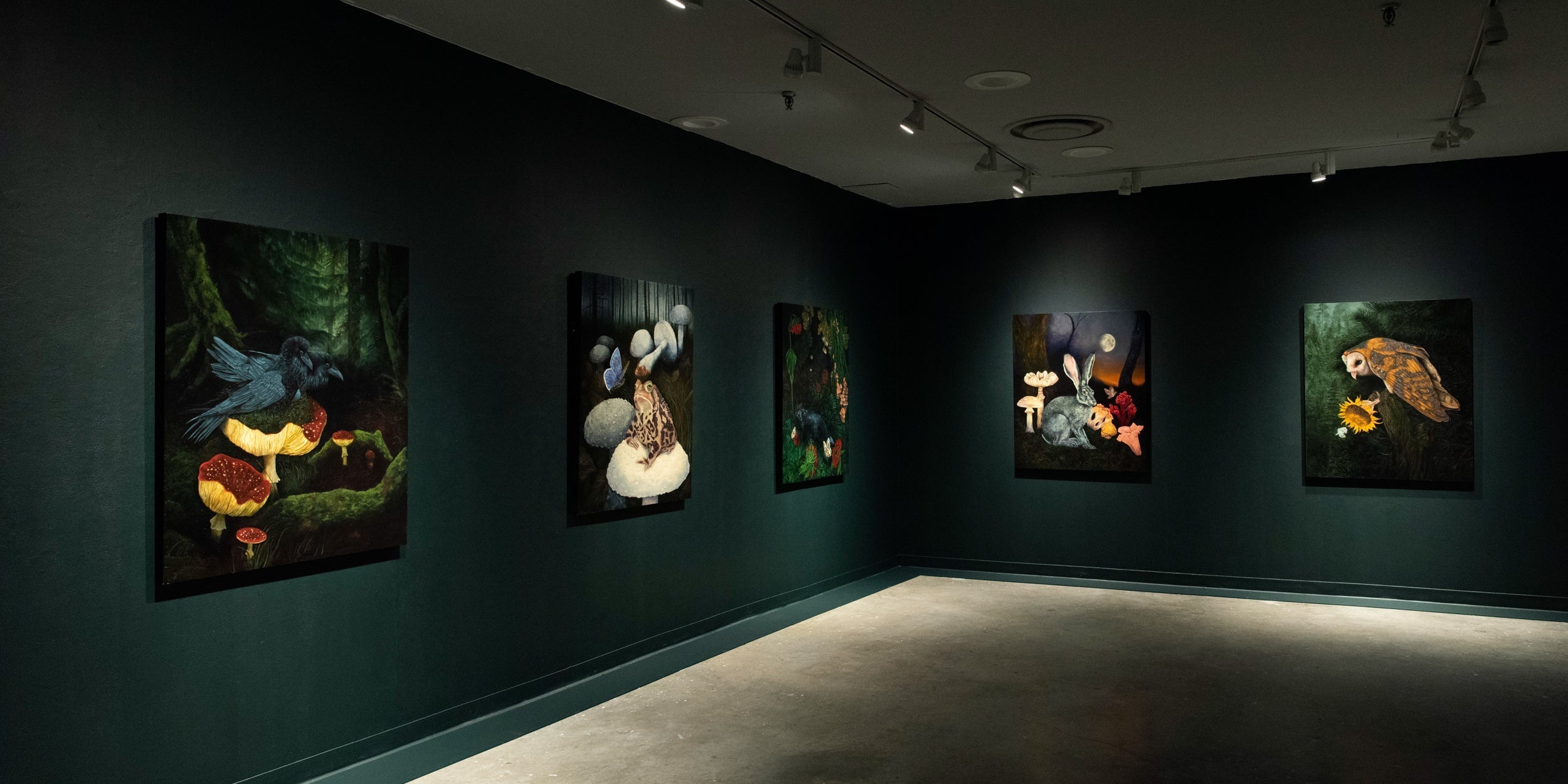
How do I represent that magic in my own work? Through impossible or improbable pairings of flora, fauna, and fungi. Even if the viewer doesn’t logically always know why the scene is magical, something in them senses it.
This wasn’t a conscious process. I’m just demonstrating how symbolic thinking can help distinguish your art in exciting ways. It allows you to take that initial inspiration we talked about, and distill how it uniquely affects you.
Once you’ve accumulated, understood, and transmuted enough of these references, you won’t feel inclined to compare yourself to anyone. You’re also less likely to be plagiarized. Not because it’s impossible to copy your work but because there can only ever be one singularly authentic artist behind it.
Protecting Your Voice: Your Body of Work as an Altar
Once we have found and honed our voice we need to protect it. My philosophy surrounding standing out as an artist and protection magic are the same: a good offense is the best defense.
In my own spiritual practice, I prioritize things like grounding and enchanting my space to be the most uniquely mine it can be. I do this over defensive magic, like wards, which are meant specifically to keep negative forces out. Not everyone will agree, and that’s okay. Spiritual practices are personal. Where I think this philosophy is universally applicable, however, is with artistic style.
I opened this essay with an anecdote about an abstract painter who ran a digital witch hunt for the artist who “copied” her. This was a defensive act, but her work wasn’t distinct enough to support it. There will be other people making pastel abstract paintings. Going after every one is untenable. A genre and palette are not enough to distinguish a visual artist, anymore than genre and a specific trope can distinguish a writer, or genre and tempo can distinguish a musician.
One of the ways many witches will protect their homes is through altarwork. The altar is a physical space filled with tangible symbols, where spirit can come through. The contents are unique for every practitioner.
As an artist, your body of work can become a living altar. The power of an altar doesn’t come from just one object, but from their accumulation. You might think of a rock as common when you pass it by in the woods, but placed on your altar—in communion with incense, statues, and other crystals—it becomes sacred. Likewise, through the distinct interplay of your palette, your mark-making, and your subjects, the spirit of your work comes forward, its authenticity forming a luminous, protective force. May this protection be wholly yours, and may it be potent.