

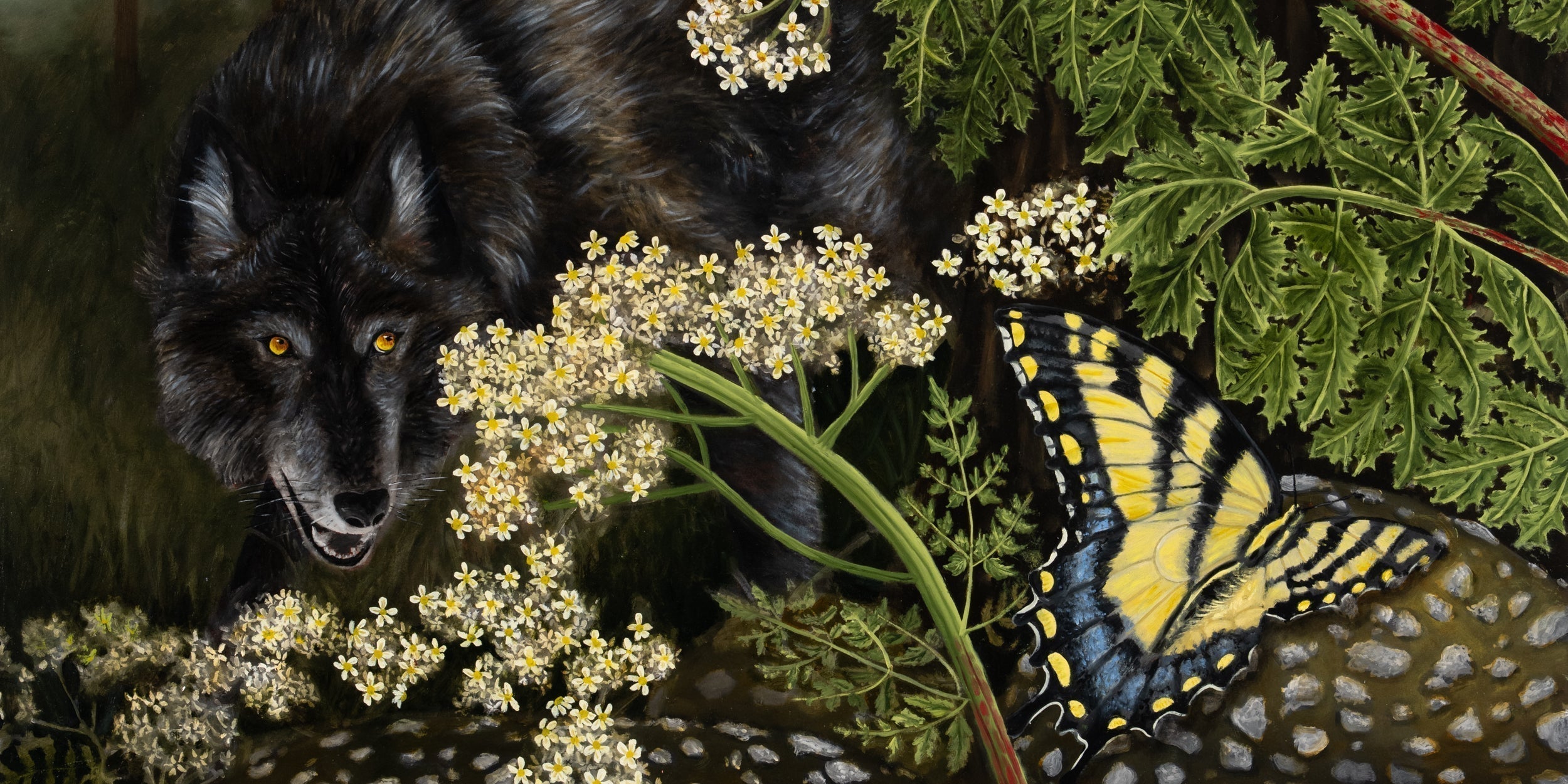
How Artists Can Thrive Despite AI: Embracing the Trickster
Purgatory is being stuck at a table, listening to someone in finance explain the creative merits of AI.
It was my cousin’s birthday dinner, and I was admiring the expertly applied eyeliner of the woman sitting across from me as she scrolled through her phone.
Eventually, I initiated conversation.
“Oh, so you’re an artist?” she asked, half an eye still on her screen. “Are you worried about AI taking your job?”
I hesitated, “Not really. I’m a painter.”
Now, I had her full attention.
What ensued was a diatribe as to why exactly I should be worried. Not because of generative AI’s myriad of drawbacks, but because—supposedly—it could replace creatives.
“You can write a whole book with it.” She insisted.
I eyed my husband desperately. He poured me more wine.
As an artist, I resist being lured into discussions about AI with people outside of my industry. Too often, I’m met with condescension. There seems to be a general disregard for the arts as practiced skills, where critical thinking and experience can lead to better results than those produced by algorithms.
I see people proudly put “AI artist” in their bios, arguing that the discernment required to iterate over prompts is equivalent to that of artists making work from scratch. This lazy kind of curation is confused for creation. As someone entrenched in the creative process, that mentality frustrates me. It feels like dishonesty at worst and a gross misunderstanding at best.
Ideating is easy. An idea is a fragile, floating thing—perfect in its nonexistence. As soon as your creative intention is given tangible form, there’s something to criticize. Bits of yourself are reflected in the art, because every element is filtered through your body.
This is as true for visual art as it is for writing or music. Inspiration moves through us. It causes the painter to mix the perfect hue, the writer to conjure a fitting word, and the musician to land
on a certain note. For these creatives, art becomes the most telling kind of mirror. All AI mirrors back at you are the dregs of whatever came before.
Meeting the Trickster
For the past century, good art has been framed as about the idea, not the physical execution. Of course the less discerning would praise the use of AI, in some ways, they’re jumping to the logical end of a precedent the fine art world has set.
As a result, we’re inundated with more competition than ever. It’s become harder for all of us—fine artists, musicians, writers—to be heard over the artificial din.
So, how do we navigate this new problem?
With subtlety, nuance and organic charm. Enter the trickster.
The trickster is a disruptor. His driving forces are primal. He’s ruled by the feelings we can’t access through logic but exist just under the surface, somewhere between our minds and our strange, animal bodies: the realm of the unconscious.
AI doesn’t have an unconscious—no caverned skull where shadows lurk, no real destructive or creative drive. For this reason, the trickster stands ahead.
In the archetype’s most potent form, the trickster is lively, nimble. He is a fox flitting through the field, the smooth dive of a raven’s courting flight.
His allure is undeniable, yet unnamable, like a twinkle in the eye of a stranger that, somehow, you’re not strange to at all. The space between the two of you speaks louder than words. He has an elusive, embodied edge.
Jung describes the trickster as “both subhuman and superhuman, a bestial and divine being…”
We would do well to be led by him.
Physical Intelligence
If artists want to be heard over the endless onslaught of AI slop, they need to embrace a type of intellect that AI can never access and the trickster has in spades: physical intelligence, a form of knowing rooted in the body. Instead, a disdain for physicality permeates creative and academic spaces. Abstraction is celebrated and embodiment met with suspicion.
This dynamic unwittingly serves an agenda. Tech companies would love nothing more than for creatives to stay disconnected, neck stiff, eyes strained, hunched over a phone screen. Embodied folk aren’t so easily convinced to part with their money or the currency of their attention.
For me, physical intelligence can be noticing the weight of a blanket on my fatigued body, or the slight numbness in my skull when the coffee and meds for my migraines hit. It’s data worth noticing, not just as a human, but as a creative. In the age of AI, this awareness sets us apart, even if we don’t know how or if it’ll show up in our art.
I see this kind of bodily knowing in the work of Frida Kahlo. She suffered with chronic pain, and the fraught relationship to her body shaped her imagery. In every painting, a material sensitivity and capacity for nuance is revealed.
While Kahlo often painted portraits, you can see her embodied experience in the settings too. It’s in the curling, fecund greens, the fleshy marks she makes. Her colours are vivid—startling. You could know nothing about her and still feel, through the work, a woman who lived intensely.
Our work as artists is deeply personal; we have real stakes in the process. We feel the shadow of failure looming and our heart beats faster, our breath catches. A skinless software’s palms don’t sweat. It knows no anxiety and no investment. Despite this and because of it, we have the upper hand.
The Power of Subtlety
Generative AI can consume huge swaths of data and regurgitate it as text, music, or imagery. The broadness of the references means the result may or may not be pleasing. What it definitely won’t be, however, is subtle. So much of the human experience is tenuous, it doesn’t lie in what’s literally in front of you, but in how you interpret it.
One of the most memorable comments I’ve ever received about my work is also the simplest.
“You must spend a lot of time in the woods.” A woman said, standing amidst my thesis exhibition.
“I used to.” I replied.
“I can tell. It’s in how you paint the light.”
The lighting in my paintings is nonsensical. Every subject within the frame is lit differently, based entirely on instinct. It couldn’t exist in reality. What the viewer was responding to, then, was a feeling I created. The untrained gaze might not know why it's drawn. Nor should it. The effect is elusive, like the trickster himself.
Staying a Step Ahead
Whilst AI gets more convincing every day, it’s not informed by the nuances of lived experience. As flesh and blood creatives, we take the time to iterate over our work. Through this process, we begin to pinpoint which details are most striking, both in our art and in life. Our taste becomes refined and our work becomes specific.
AI may be able to convincingly imitate a brush stroke, or replicate our intonations after the fact. What it can’t do is understand why we create. You know that rush you feel in your stomach when a story must be told? Like moths fluttering, only more urgent, tickling your throat. That feeling is a compass. It points you toward what’s worth saying, and what's a tired cliche. The devil’s in the details—and what a handsome one he is.
The artists using AI as a medium are thinking in broad strokes. Many see the process of going line by line or frame by frame, as an inefficiency to solve for. If you’re a traditional artist thinking just as broadly, then of course you’ll be replaced. That approach was unlikely to yield success anyways. You can’t bludgeon creative work into being. More than ever, you must be exacting.
When whittling down your life into art, skip the axe. Use a scalpel. If artists gather round a tree, the trickster among them will climb it—hanging from an ankle, just to see the bark up close.