
Article: Why Artists Need Familiar Spirits in the Age of AI

Why Artists Need Familiar Spirits in the Age of AI
The summer before starting my MFA I was asked the same question over and over “How are you going to dismantle your practice?”
If the word hurled my way wasn’t “dismantle” then it was equally aggressive: dissect, disrupt, interrogate.
Half a decade later, I can tell you that it wasn’t fear that made me squirm when asked, but a difference in philosophy. There was plenty I wanted to learn: how to ground my subjects in a setting, how to paint more authentic textures, how to take a fleeting idea and reliably make it real.
But that wasn’t about dismantling at all. It was a process of burrowing into my passion.
I don’t see any value in uprooting what has just been planted. Nothing substantial grows when you’re moving onto the next “best” thing. This pattern plays out everywhere: lack of expertise gift-wrapped in the loudest opinions. Progress that, too often, isn’t progress at all.
In the age of AI, when people have a slew of information and so-called “creative” tools at their fingertips, mastery has become more important than ever. As a creative, this isn’t a time to burn everything down. It’s all on fire already, and mediocrity abounds.
While everyone else seeks novelty, seek the familiar, and know it deeply. It’s where your power lies.
Finding Your Familiars
In traditional witchcraft, a witch’s familiar is a helping spirit. The familiar would aid a witch in completing her spells on the etheric plain, in exchange for some kind of continued offering.
As an artist and witch, I’m never far from my familiars. I hear a greeting in the raven’s croaking, catch a knowing in the fox’s eye. Even in the city, they’re with me: shadows flitting in vacant corners, a sound that could be the apartment settling, or claws on my landlord’s laminate.
Your familiar spirits can appear in infinite guises. They don’t need to be animalic, like mine are. Instead, they’ll consist of the themes, symbols, and elements that haunt you.
Think of inspiration itself as a delicious haunting. Artists are possessed, incensed. Our work’s borne of compulsion: silent whispers egging us on. Just one more stroke, go on.
Those words belong to your familiars, and they’ll animate your art. Noticing them is simply a matter of repetition.
Ask yourself: What am I always excited to create? What shows up in my work, again and again?
Despite the art world’s (and internet's) obsession with novelty, the more time you spend basking in the presence of one motif, the deeper your connection.
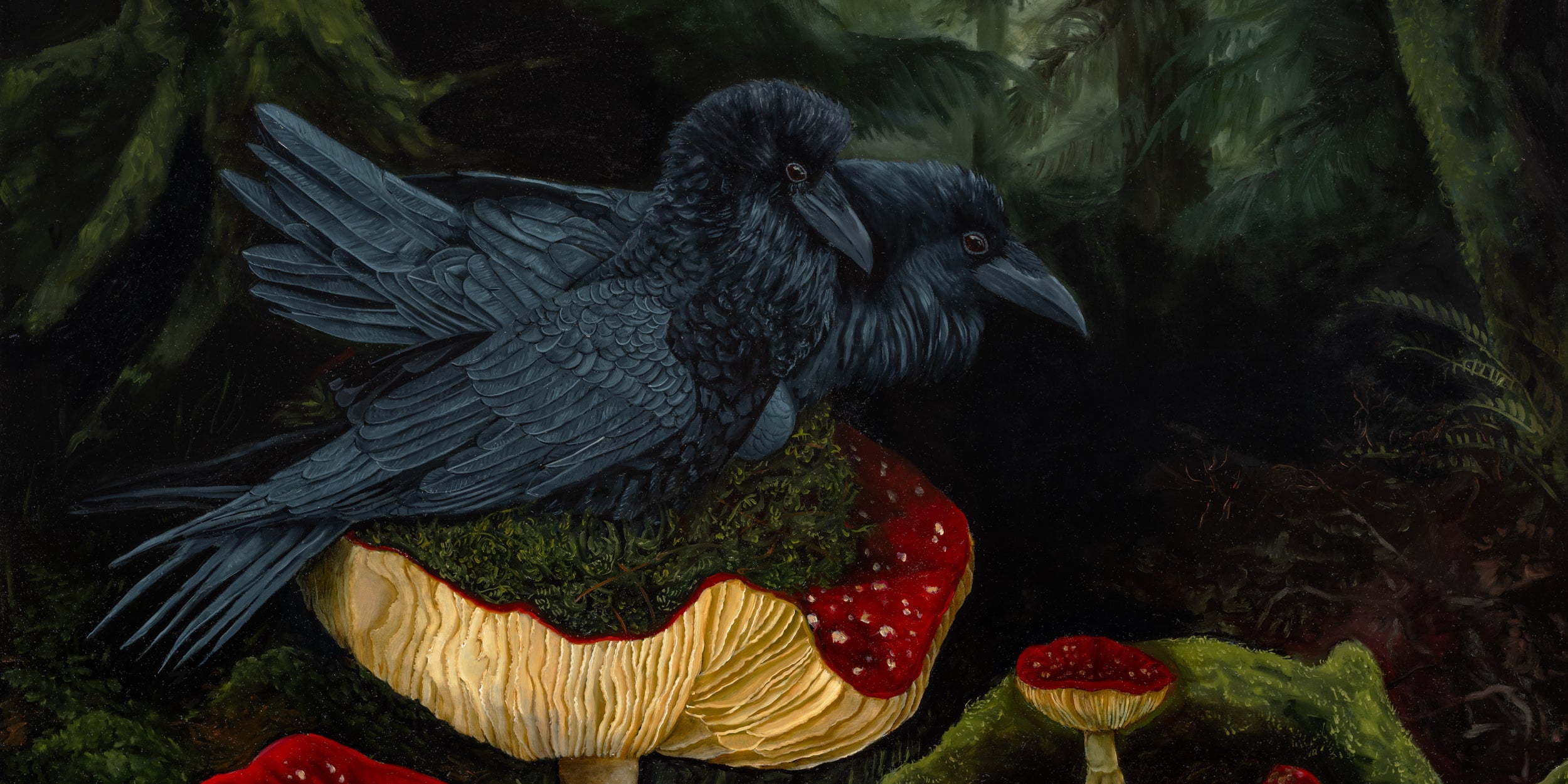
I’ve been painting very specific fauna, flora, and fungi since undergrad. I view them all as my artist’s familiars, and assure you that my rendition of them is more sophisticated, and more powerful now, than it was five years ago.
Had I listened to peers and completely upended my practice during grad school, I would have never known the satisfaction of deepening those relationships. I’d also be making weaker art.
With the widespread accessibility of generative AI, telling artists to innovate for innovation’s sake has aged particularly poorly. When people peruse huge amounts of data, they retain very little. As a result, their messaging ends up all feeling the same. It’s why AI prompters make hollow art.
As an artist, you can challenge yourself with depth over breadth. That is, your work can evolve by exploring a subject, medium, or technique more intimately. Through repeated exploration, those elements become familiar to you, and the bond you create shines through your art.
This is what allows some of the most notable creatives—writers, musicians, painters—to become iconic.
Intimacy, not Novelty
In the past, people accused of witchcraft were searched for “devil’s marks”. Any mole, skin tag, or birth mark could be suspect. From that mark, the familiar of the alleged witch could supposedly suckle blood.
While this is a horrific application of the concept, there’s a resonant truth within that exchange. The more of your life force you give to a creative endeavour, typically, the greater it serves you.
In the case of the witch’s familiar, this energetic binding was thought to occur through the literal exchange of blood. I’ve seen references to the offering of less sensational substances, like milk or liquor, as well.
As an artist, you give your life force in the form of time and attention.
The Old World concept of a familiar spirit may set some of you more adventurous creatives on edge. It can feel prescriptive, arbitrary. Who wants to be forced to engage with the same subject matter over and over?
To which I would reply, no one’s forcing you.
The path of the familiar isn’t for everyone. But it is valuable, more so than it’s made out to be in our current climate.
If you feel lost in your practice, that you're missing that magic “something” that makes others’ work sing, it may be that you haven’t deeply committed to a specific direction. Commitment doesn’t equate to a lack of imagination or pleasure—quite the opposite. It takes imagination to find magic in the familiar. It’s the most imaginative lovers who never tire of each other.
When I first started writing these essays, I feared that every single one was a one-off. That’s because I haven't fully given myself to the project yet. When I write, my familiar theme is magic and creativity. Can I keep finding interesting angles to explore that from? I think so, but I’m not sure.
I can only become sure through doing.
The familiar subjects of my paintings, meanwhile, I’m certain of. I’ll never tire of painting the raised landscape of a toad’s skin, the flitting quickness of its tongue—something which, to others, might quickly seem dull. I know this because I’ve done it for years, and adored the process each time. So much so, that I feel called to do it countless times more.
Surviving AI Witch Hunts
During the witch hunt craze of the 15 and 16 hundreds, household pets and livestock were often accused of being familiar spirits in disguise. The animalistic has been tied to evil, and it didn’t take much to be regarded with suspicion.
In some ways, it still doesn’t.
Artists are often strange, and four hundred years ago, that strangeness could have got you hung. Now, it seems, it can get you accused of sounding like AI—simply because your work doesn’t meet someone else’s idea of what “authentic” art should be.
A writer who uses one too many em dashes or similes might be accused of relying on ChatGPT, just as a painter working in a particular palette or subject matter might be accused of using artificial reference. In both cases, the suspicion may simply stem from AI prompters also favouring those elements at a given time.
One thing hasn’t changed with the centuries: those who would benefit from your disrepute will be the first to point fingers, no matter how feeble the evidence. If we start accusing every peer of being influenced by AI, we actually level the playing field for those using it as their “medium” of choice.
The public’s suspicion, though harrowing, is understandable. There’s no shortage of people pretending to be artists. With AI, posing has become easier, and more lucrative, than ever.
Nonetheless, the worst thing you could do is center AI over your familiars. When you modify your art so it registers less like AI, that’s exactly what you’re doing. Realistically, it’s not stylistic tells alone that make something seem software-made. If an em dash helps you translate your familiar’s urges—use it.
When you become bound to a subject or way of working, at least for a time, your foundation is steady. You’ve developed the skill of being interested, something that allows you to focus on a specific direction, rather than getting swept up by the competing chaos of the external world. What other people are saying, or shifty softwares are doing, becomes irrelevant.
You know what your work is, and it knows you too.