

Fairy Temporality: Balancing Awe & Admin as an Artist
As a child, I would often get chastised for daydreaming, my mind wandering somewhere with the faeries, only to find a whole lesson had passed. One moment I would be there, doodling in a textbook’s margins, the next floating far away, the teacher’s instructions fading to nothing but the rustling of leaves in my inner landscape.
Creatives know that time is slippery. At its peak, the creative process is a fever. Its heat blurs the world’s edges so that even the ticking of the clock is distorted, like sound traveling under water.
Many of us crave this sweet release, to feel the weight of reality lift off our shoulders. Despite the craving, we’re consumed by guilt after spending time in that altered state. Then, when we don’t (because we’re locked at our computers) we feel equally guilty for evading it. After all, shouldn’t we be making art?
This guilt, while understandable, is unproductive and exhausting.
For creatives, periods spent outside of time are just as necessary as those spent at a keyboard. The challenge lies in reconciling the daily, time-bound responsibilities of outreach and admin with that otherworldly state of awe.
To balance the two, I suggest we seek counsel from the land of faerie.
Fairy Time vs Mortal Time
For centuries, fairy lore has warned about the subjective, unstable nature of time. In written tales, it’s often poets and artists who wander off with the fey, only to find that what felt like three days of revelry in the enchanted realm was 7 years in our world. I don’t think it's a coincidence that the victims of this kind of distortion are often creatives.
Creative immersion has similar effects as entering the realm of faerie. It alters our sense of temporality and we become ecstatic. We might as well be beneath an elven hill, drunk on strange wines and dancing furiously—unaware of our screaming feet.
The inverse can also be true. I’ve certainly sat at an easel while in the throes of resistance, the minutes passing like hours in my frustration. In that state, art making doesn’t feel any different than writing an email I’ve been avoiding, or taking care of that month’s accounting.
Awe expands time inwardly. We emerge from awe shocked that the sun has set as quickly as it has, while simultaneously impressed with the breadth of work we’ve accomplished. In that altered state, our capacity is so heightened that our output is equivalent to that typically produced over a longer period.
Meanwhile, for many of us, admin compresses our internal time. It can feel like we’re racing against the clock, or at the very least rushing to keep up with it over the endless pile of busy-work.
It would be a false dichotomy to frame these two opposing states as either good or bad. They just are. As artists, our task is to become aware of how time expands and contracts so that we can learn to best utilize both. When you identify whether you’re operating in “mortal time” or “fairy time” over a given period, you can create ritual structures to honour each.
Protecting Fairy Time
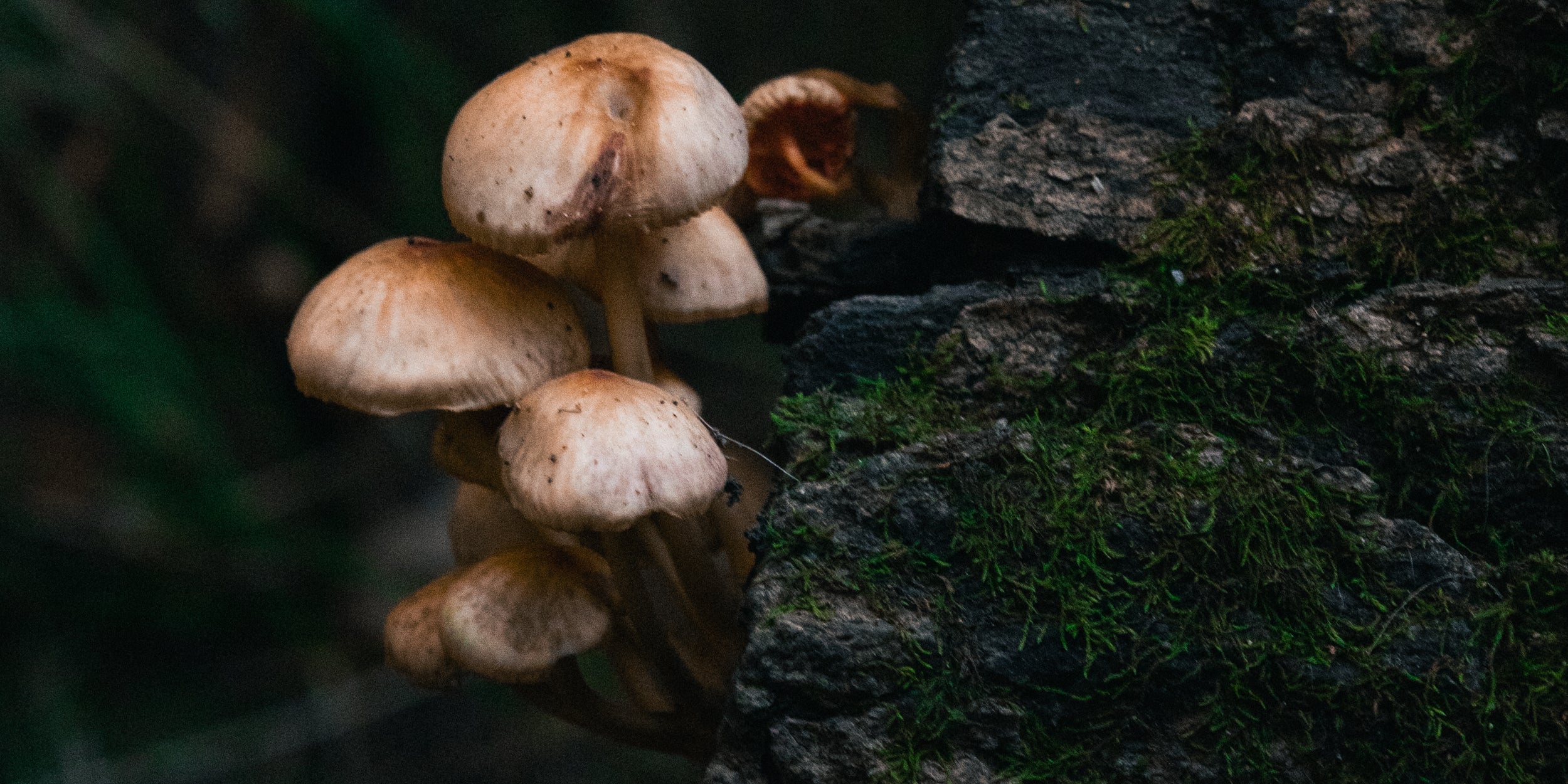
If you were ever trying to access the realm of faerie, a sure-fire way would be to stumble into a mushroom circle. Historically, the phenomenon was called a “fairy ring” and feared for this very reason. Enter at your own risk, you may never return.
As artists, we can look at the mushroom circle as a framework for organizing our creative time. Notably, there should be a very clear boundary between what’s allowed within the circle, and what must remain outside it.
If we approach our creative process with boundaries and respect, then we’re more likely to be spirited out of the mundane.
For me, at the most basic level, this looks like removing my phone from my work space. It can be tempting for visual artists in particular to have one within reach, so they can document the process for social media.
This is a breach of the circle.
When you take out your phone to capture a moment of flow, you’re shattering the very state you wanted to document. Not only are you breaking your own concentration, you’re allowing whatever energy you’ve built up to flit away. Call it a distraction. Call it a spited spirit. Either way, it’s a problem.
Faeries are easily angered and don’t take well to insults. A common facet of the lore is that a fairy, upon realizing a mortal can see them, will disappear, often leaving behind a curse to remember them by.
While the muse may not be so vindictive, she is equally elusive. You want to look at her from the corner of your eye, let alone avoid staring at her through a screen.
Faeries are tricky, capricious beings. Their myths are full of taboos, the breaking of which lead to dire consequences. As artists, it’s our responsibility to get to know the taboos of our own practice. That’s how we conserve awe.
Reframing Mortal Time
Mortals returning from the land of faerie are often disoriented. So much so that the state of being bewildered or physically lost was often referred to as being “pixie-led.”
At first, being subject to mortal time, and the resulting confusion, might seem like punishment for leaving Faerie. But what if, instead, it’s the hearth waiting for us when we return, a place where we can find a different kind of nourishment? After all, the work we do outside of our practice allows us to put food on the table. We simply need to treat mortal time and its accompanying tasks with as much respect as the creative process itself.
When distinguishing between whether to engage in fairy time or mortal time, it’s not necessarily about how much energy we have at our disposal, but what kind. The focused, task-driven energy that makes emails easy isn’t the same as the open curiosity that invites the muse.
For example, as much as being engrossed in creativity might seem like something that would fuel you, it takes in physical and mental energy as much as it gives in spirit. That’s why I don’t resonate with the advice that administrative work should only be done after creative work has already been made.
Jumping into mundane tasks after a bout of inspired creativity can make the already sometimes unpleasant process feel even more like an uphill battle. I find that when I tackle the mundane “have-to-do’s” before I’ve exhausted myself creating, they become a lot more pleasant.
We should be doing our best to neither squeeze admin right up against periods of awe, nor to try squeezing awe right after admin. Both need room to breathe. While I can explore specific tactics to create this breathing room in later essays, I want to offer a reframing for the often dreaded process of admin: look at it as an offering you give to your practice.
In parts of Europe, offerings of milk and honey were often left out for the fey. Admin is the offering you give to your art so that awe has the chance to come forth. The sacrifice is made in service to the art, not the other way around.
When you frame admin this way, you avoid casting it as either an unimportant nuisance, or as something that’s so pressing that it can interrupt your art making. Instead, the admin feeds your practice.
Tend to your mortal tasks as diligently as you do the rest of your process. When you look at administrative work and artistic awe as being symbiotic, you’ll feel much less conflicted when pursuing one over the other. Either way, you’ll get around to both. The fey favour those who keep their bargains.