

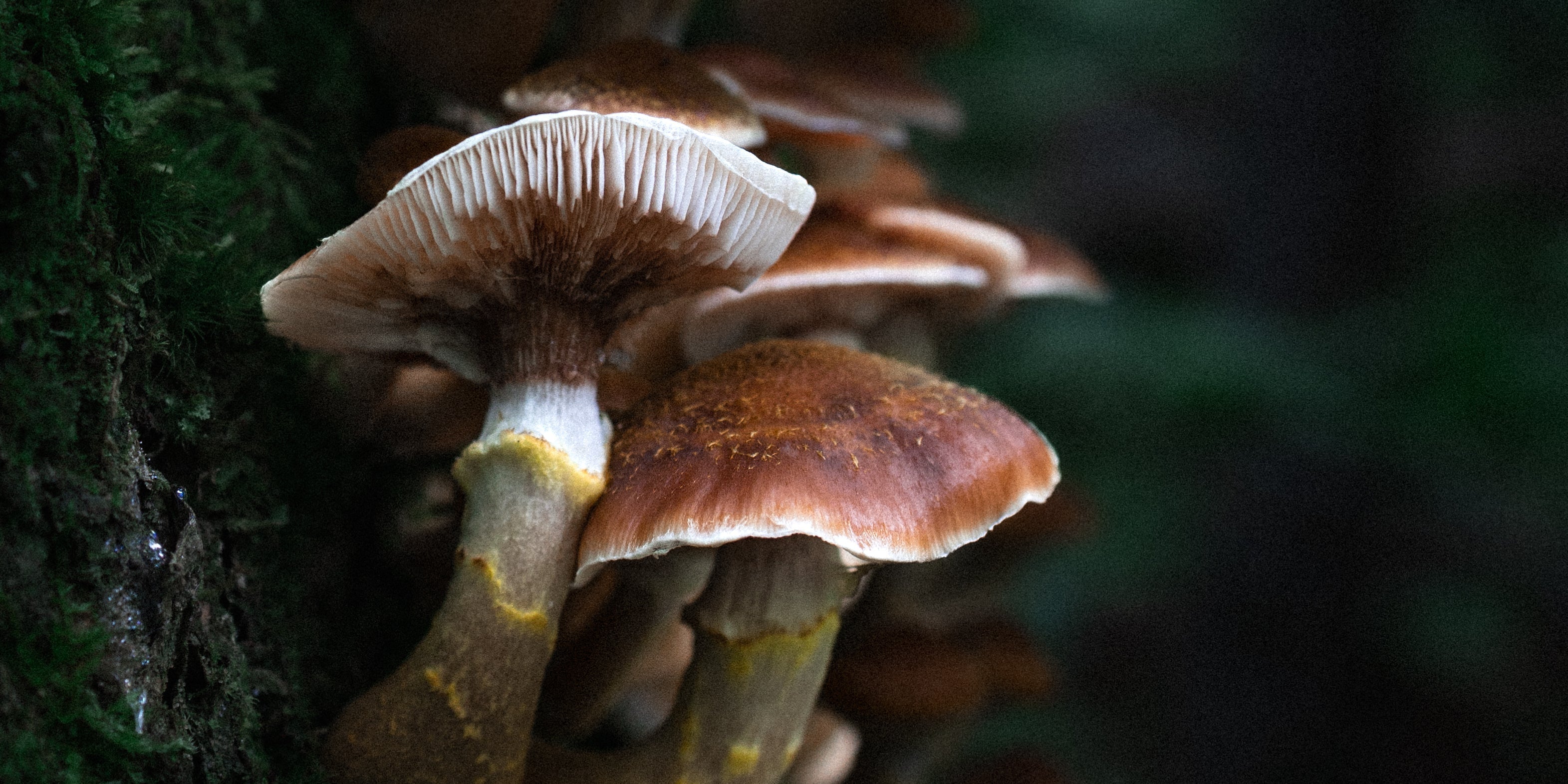
Mycelial Muses: Attention, Allure & the Forest Floor
A Kingdom of One:
Holding Your Ground
You know a mushroom when you see one, bulbous and crouched in the undergrowth. Someone uninterested in nature might not be able to tell a birch from a beech tree, but a mushroom’s shape rarely resembles anything else in the woods. Despite this, fungi were long classified as plants. It wasn’t until the latter half of the 20th century that they were recognized as a kingdom unto themselves.
Today, we inhabit a space more visually eclectic than any forest: the internet. To stand out, every creative must also be a kingdom of one. This doesn’t require constant innovation. Fungi have thrived for over a billion years and still capture the imagination. What defines your kingdom is your unique allure, an energetic signature as impossible to define as it is to ignore.
For the Few and Far Between
A couple of years ago, a dental hygienist politely asked what I do for a living with her hand in my mouth. I garbled a reply and immediately regretted it. Within seconds, she had removed her gloves, pulled out her phone, and began scrolling through my site.
“You’re very good, but have you ever thought of painting flowers? Who wants mushrooms on their walls?” Then, after a pause, “Is that a frog?”
“Close. It’s a toad.”
Walking home on the snowy sidewalk, I mulled over the exchange. My collectors definitely did want mushrooms on their walls. But in the dentist’s office, it seemed absurd. I was all too aware of the paper bib at my neck, the saliva pooling at the corner of my lips, and the casual incredulity of her tone.
Many creatives think allure entails beaming as brightly as possible in whatever room you’re in. But we’re not meant to shine in every environment. It’s better to stand quietly in the value of your vision than to implore others to understand it.
In European folklore, mushroom circles were thought to be portals to the unseen or faerie realm. As an artist, you are a gateway into the world of your work. Those longing for what beckons from the other side will look down, then enter. Everyone else can stroll on by.
Tempting Underfoot
For many of us, the idea of going unseen isn’t actually what stops us from putting ourselves out there. In some ways, we’re used to it. More ominous is the possibility of being recognized for exactly what we are.
As a painter, fly agaric is one of my favourite subjects. You’ve seen her before, burning red and speckled with white. Folklorically, she’s associated with witches, madness, and the otherworld. I think of her as a gorgeous devil.
A vivid mushroom, like a beautiful woman, is a disruption to the landscape. She arrests the gazes of passersby. They resent her power, so she becomes tempting underfoot. Boots ache to crush her.
Attention can be dangerous—artists know this. As a result, many choose the obscurity they claim to hate. I certainly have. And yet, for professionals, attention is the currency we deal in. This was as true before the internet as it is now. The only difference is that these days we can cast a broader net, rather than fighting to be seen by a specific industry figure.
The first time I received any kind of viral attention online was in November of 2023. For months prior, my skin felt like I was wearing it inside out. Even an errant look was enough to make it crawl. This threw a wrench in both my personal and professional life. I chose to remain largely inactive online, hoping the sensation would pass if I took a break.
As autumn gave way to winter, it did. On impulse, I posted a reel of all the paintings I had completed in the past two years, and it took off.
Hundreds of thousands of strangers had me suddenly popping up in their feeds, like mushrooms burst from the soil after a storm. The reception was largely positive, my audience growing from around two thousand to over twenty thousand in a matter of weeks.
A natural consequence of having more people see your work is that you’re subjected to more opinions than you might be otherwise. Fortunately, despite the fear many creatives stoke within themselves, only two things can happen: someone can be right about you, or someone can be wrong.
As my reel gained more momentum, a few male artists publicly speculated in my comment section: who was this random woman on their feed? Clothed in a long-sleeved crewneck and stiff, paint-stained apron, she was obviously abusing her feminine wiles. Their assumptions were blatantly false. I wasn’t trying to “seduce” my viewers. At least not in that sense.
Then there was another comment, this one true: “Not impressive. Nothing new here.”
This artist was right, it wasn’t new. My work directly ties into a tradition of natural illustration, fairy tale illustration, and chiaroscuro painting. To the frustration of certain professors, I have never been interested in innovation. For me, novelty isn’t the point of painting. Humans were doing it on the walls of caves. The purpose is resonance.
The commenters’ intentions were malicious, but in no way took me off-guard. The key to being able to bounce back from this kind of negative attention is to be sovereign over your own creative world. Know your internal cartography. If you do, how could an invading force stand a chance?
Raising the Drawbridge
When I first moved back to Montreal after finishing my MFA, I was overwhelmed. The men in my neighbourhood were remarkably pushy. It didn’t matter if I had earbuds in, or wore a black, shapeless dress over my workout clothes. My very presence seemed to function as an open door.
The interactions were only mildly annoying until they grew into something more threatening. After one particular exchange, I entered my apartment and promptly burst into tears. I was tired of being perceived. More than that, though, I was pissed.
It was the kind of anger that seems to replace all the blood in your veins. The boundary between hot and cold blurs, and suddenly you can’t tell if you’ve frozen over or are burning up. I thought of men I’d known—of broken phone screens and holes in drywall, the nagging conviction that it was my fault. Was this the rage they let be so easily provoked?
Suddenly, I saw the weakness in it. My pity wasn’t righteous; it was nauseating. I viewed my aggressors as pathetic for so impulsively wielding what in me had been worn down: molten liquid under rock, eroded by transgressions.
My husband came out of his office to greet me at the door, confusion on his face as he removed the gym bag from my shoulder.
Splashing myself with lukewarm water, I decided I was no longer going to entertain unwanted attention. There would be no smiling or scowling, no slowing down to hear someone out, and no speeding up to get away.
Back straight, pace steady, I would be a castle unto myself. Stare all you want. The ramparts can’t look back. They don’t even know you’re here.
Your Own Cavalry
Truffles are a delicacy that have been prized for thousands of years. Their unique flavour and aroma make them amongst the most sought after mushrooms on the planet. Historically, hogs were used to sniff them out. While I have nothing against literal swine, being unparalleled means you will undoubtedly run into the human variety.
I won’t tell you that you need to turn to stone to avoid harm or that you need to feign total indifference like I do when navigating public spaces. I will tell you, however, that you need to learn to implement boundaries if you ever want to cultivate the courage to be distinct.
The idea that we’re all unique is cliché because it’s true. Most of us have just couched our strange magnetism under several layers of dirt. We stay huddled within, terrified of landing between someone else’s careless teeth. Boundaries are our armour. They give us the courage to rise to the surface.
Three summers into living in this neighbourhood, I’m no less frustrated when I get accosted. My resolve doesn’t magically repel negative attention. Boundaries don’t control our external circumstances. Rather, they dictate how we react.
When someone approaches me unprompted, I don’t engage. My safety and my energy are my responsibility. The ego of an entitled stranger is not. I navigate the online world similarly. Hateful commenters are blocked.
Your boundaries may look completely different than mine, because they guard against the specific gaps in your own armour. Remember that you are your own cavalry. If there’s anyone worth sticking your neck out for, it’s you.
Inside the Circle
Once we’ve claimed our own territory, the next step is not only to protect it, but to inhabit it fully. Anger can be a catalyst for courage, but long-term, it isn’t sustainable. This is where glamour enters: the quiet power of self-possession.
When you hear the word “glamour,” you may picture black and white portraits of Old Hollywood starlets, but the word is older still. In the Middle Ages, it was used to refer to spellwork, both the kind learned in occult studies and the natural enchantment that supernatural entities like the fey employed.
Most of us have probably seen cutesy illustrations of winged fairies lounging on mushrooms at some point or another. Those aren’t the kind I’m referring to. The fey of folklore were more femme fatale than flower faerie. Their allure was dangerous, unknown.
To me, mushrooms are glamorous in that they emit an irresistible pull. Both fungi and faeries carry an otherworldly allure. Fairy palaces were often thought to exist underground. It makes sense for someone to think that entering a mushroom circle—an apparition sprung from the soil overnight—would take you there.
As a kingdom of one, we are grounded and protected. We don’t allow others to waste our time or siphon our attention, because we know that when we turn it inward, gorgeous things emerge. We can take up space and allow ourselves to be perceived, knowing that no matter how people react externally, within the circle, we are strong.
A Feral Feast:
Finding Your Texture
When most people think of fairy tales, they think of royalty. But many tales begin outside of the castle walls. A peasant goes to the woods to forage. There, they are met with the unseen, the terrible, or the sublime.
The search for sustenance, triggering a spiritual journey, is particularly relevant to artists. Creative work feeds the imagination, not only of the artist, but of their audience.
In marketing terms, a creative’s audience might be referred to as their consumers. The word rubs many artists the wrong way. The idea of having a “consumer,” in addition to being overtly capitalistic, poses a threat. What are they consuming? You?
Well, yes. But only a fraction of you.
What often makes an artist’s persona so alluring is that we don’t see everything. Artists are like mushrooms in this way. Mushrooms are just the fruiting bodies of fungi—the visible part of a mycelial network. We can admire, pick, and cook the mushroom. But the mycelium remains.
An artwork’s allure comes largely from the labour behind it. There needs to be some kind of texture or friction in the making for people to become truly hooked. The creative process weaves an invisible spell that elevates the art as well as the artist. Learn to revel in it, and you too can let them feast.
A Memorable Villain
As a child, I was insatiable for fairy tales. I would implore my mother to read from the same anthologies over and over, protesting if she dared skip a beat to move bedtime along.
Despite years spent poring over illustrations, no princess stands apart in my memory. They’ve merged to form a beautiful but anonymous figure: blonde-haired and blue-eyed, like every heroine drawn for those stories was.
The only character I can bring to mind is a villain, dark-haired and dark-eyed, like me. I could chalk this selective memory up to vanity. But it was the role she played that stuck with me.
The story begins like many fairy tales. A virtuous damsel is sent into the winter woods by her stepmother with an impossible task—to find strawberries beneath the snow. Carrying only bread crusts, she stumbles upon a cottage where seven dwarves live. She offers to share her meagre meal with them and in return, they grant her a gift: whenever she speaks, gold coins fall from her mouth.
When the stepmother learns this, she is furious and wants the same for her own daughter. She sends her out at night with a basket of baked goods. But when the dark-haired daughter meets the dwarves and they ask for a bite, she refuses. Henceforth cursed, toads emerge from her mouth whenever she speaks.
In bed, I would imagine the sound of toads plopping onto the hardwood floor. What a relief it must be to be able to speak out the discomfort, to have your awfulness manifest in a way you could point to. Perhaps for a moment after each toad emerged, the stepsister felt lighter.
There’s a lot we could unpack here—about the depiction of women, food, and selfishness; about who looks like a heroine and who looks like a villain in European fairy tales. For the purpose of this essay though, what matters is the stepsister’s salience.
I was drawn to her not despite her transgressive nature, but because of it. Her selfishness both appalled and fascinated me. I wanted to be able to say no. To feel so worthy that shame no longer touched me. To take what was inside me and externalize it, so it stopped being my problem alone.
Your Poison Is Your Power
Despite being visually unassuming, toads have long held a prominent place in folklore. Often associated with witchcraft and the occult, their presence was linked to mystery, transformation, and malefic power. It was even said that they guarded fairy circles, hence why poisonous mushrooms are sometimes referred to as “toadstools.”
I suspect their magical reputation stems from their physical traits. If you’ve ever spotted a toad on a walk, only to lose sight of it moments later, you understand how effortlessly they blend into the undergrowth. In this way, they possess their own illusory glamour: here one minute, gone the next.
While there is something enchanting about stumbling across a tiny, round-eyed creature, toads don’t invite human touch. Instead, they secrete a milky toxin. This contrast lends them an ambiguity—both alluring and unsettling. If there’s one thing people love to gossip about, it’s someone (or something) that dares defy expectation.
I enjoy painting toads and mushrooms for the same reason: their texture. If you were to run your finger along a toad’s back, you would feel that the skin is dry, curving into mounds and grooves, up and down. My favourite mushrooms have these same shifts in surface.
The princesses in my mother’s book of fairy tales all bled into a single figure because they lacked texture. Not just because the illustrations didn’t differentiate them, but because of their actions. We know what the script of a “good” girl or woman is. Perfection is sameness. Deviance opens up a world of possibilities.
When I identified with the evil stepsister as a child, I understood the allure of her indiscretion. As an adult, I still empathize with the impulse to exorcise toxins from one’s being. In the story, the toxins were the toads leaping out of the stepsister’s throat. In reality, they can be a memory, an experience, or a chip on your shoulder.
Keeping the hidden magnetism of fungi in mind, however, I think we can come up with a much more artful approach than baring all. Art can function as a purely cathartic pursuit, but I think the most interesting artwork does more than that; it’s two-fold. It carries the texture that hooks an audience, but also offers a balm for the resulting friction. It is discomfort, then relief.
Breaking Character
Have you ever regretted the words coming out of your mouth even as you’re saying them? I experienced that often in my teen years. Conversation would be going fine, and then I’d slip: a sentiment expressed with too much enthusiasm, an overly cryptic observation.
The reason I fell in love with my husband was that he understood the rules I couldn’t grasp, but purposely turned them on their head. His humour was subversive, and he was charming enough to get away with it.
I remember once feigning exasperation and sighing, “Why are you like this?” He grinned and shrugged, “Because it’s fun.”
And it is.
My husband has never been funny for anyone else’s benefit. His texture is self-sustaining. It blurs the lines of propriety, but not decency.
Most people are uncomfortable with blurriness or ambiguity. When foraging for mushrooms, one must be wary of it. A false morel may be mistaken for a true one, a destroying angel for a harmless meadow mushroom. Rather than learning to spot the difference, some decide it’s best to stay out of the woods altogether.
They’re missing out.
We don’t realize we’re operating from a preconceived script until the rhythm is broken. Once it is, we laugh—incredulous. It’s a moment of pure release, and we begin to crave more of these subtle breaking points.
A fairy circle is a breaking point in the fabric of reality. When I create texture in a painting, I do it by disrupting a colour with darker or lighter shades. That’s how contrast is created. Without it, my paintings would be overly smooth. Your gaze would glide right off the surface.
An artist who is true to themselves acts as an interruption. This doesn’t require being obnoxious or loud. It can be incredibly subtle: a white mushroom cap peeking through the pine needles. A bur that doesn’t scratch your skin but clings to your sleeve.
This is how to be memorable.
The Consumed and Consuming
As an artist, your hunger will save you. We know that many of the attributes espoused by fairy tales are admirable traits: generosity, kindness, humility. But ultimately, to create something out of nothing, you need to listen to your longing. When someone asks what you saw in the woods, you don’t need to tell them.
Sometimes it’s enough just to hint.
Texture comes as much from what you don’t share with others as what you do. In a joke, texture can be the subtext. In my own paintings, it’s the part of the image where the landscape fades to black. The empty space makes what appears on the panel all the more striking.
When people partake in our world, they’re not doing it without a cost. They say that if you enter a fairy ring, what feels like a night of dancing amongst the toadstools might really be seven years. When people give us their attention, they’re paying with their time. Feeling entitled to the engagement of others and frantically oversharing to get it creates the opposite of allure.
The work, then, is not to feed everyone until you’re emptied, but to cultivate an atmosphere where your hunger and theirs meet. Let them taste, let them wonder. What you withhold sustains you, and what you reveal sustains them.
Strange Soil: Seeding Desire
It’s the bold, fruiting bodies of fungi that initially draw our attention in the forest: remnants of a strange feast, left abandoned overnight. Yet I suspect their illicit pull comes from what we don’t see. We sense something more murmuring underground—whispers that create a magnetic aura.
We’re drawn to mushrooms for the same reason we’re drawn to art: something hidden has bloomed before us. An artist is a forest floor. Things teem under the surface, speaking in a language few remember.
I think of the stoic faces in family albums, some black and white, others in faded colour. My grandmother pronounces the fates of the photos’ subjects like a subdued banshee. One died on the job. Another drowned three months later.
I look at the tanned, wrinkled skin of her hands and think of the blood pumping beneath. In her village, people ask who you’re from, not where. She announces another death sentence. I get up to make espresso.
My grandmother’s trauma is the soil I was born from, a compost of memory that feeds my work in unseen ways. So is her laughter and the florals she embroiders, all spores that root in my subconscious. I am not a masochist. I don’t find beauty in pain for its own sake. But how can I fault dirt for the matter within it? Where there is nourishment, there must be a corpse. Mushrooms feed off decay.
Even the fig trees overtaking the ruins of my grandmother’s home come from rot: a delectable promise of life after death. They remind me that there’s a world beneath this one: a ghostly kingdom of organic architecture. Fungi live there. So do artists.
You’ve likely felt the presence of this unseen reality, its ache and warmth. Maybe, like me, you were born with thin skin, gossamer as the veil between worlds. So much of the mystique of the artist comes from our permeability, an attunement to the ecosystems we live in. We know to seek more than what meets the eye.
A lone mushroom is never the whole story. It’s tethered to mycelium. These fungal roots revel underground, and when conditions are right, conspire to rise—spectral beings made flesh in the undergrowth. For every artwork, be it a painting, song, or poem, countless invisible narratives branch out beneath. These silent stories make the mushroom and the artist irresistible.
A Lunar Disposition
In a world that’s heavily digital, it can be easy to feel like whoever shouts the loudest online will succeed. In some cases, that may be true. But the artists I love most, especially musicians and writers, draw me in through allusion rather than directness. The ambiguity leaves room for interpretation, blurring the boundary between my own life and their work.
Folklorically, mushrooms are associated with the moon. Those drawn to fungi often feel more at ease in the diffuse light of the stars than in the glare of a cloudless day or a glowing phone screen. I wonder if that’s why mushrooms are so prevalent in artwork. Many artists are shadowy people. We like there to be some murkiness, a hint of nuance to sink our teeth into.
In my early twenties, when I was trying to chase the approval of others, I often felt like a frog who wandered too far from my pond and was now being scorched by the midday sun. It wasn’t that I was ashamed of sharing. I just wasn’t in my element.
I felt compelled to speak before I had fully crafted what I wanted to say. For some artists, this works extraordinarily well. They think out loud and learn in public. We become fascinated by their lives precisely because of how they beam outward, bathing us in comforting rays of minutiae.
I would say that creatives like this embody solar energy. Transparency increases their visibility and momentum. It’s why they often shine on short-form social platforms, where their innate charm is instantly disarming.
Lunar creatives like to spend a bit more time in the mud: feeling, absorbing, transforming. That’s why they might be better suited to formats like essays or long-form video.
Most of us carry both the lunar and the solar within us. The proportion may shift with the seasons of our lives. While solar traits are more often celebrated, a lunar disposition—contrary to what many marketers and creative coaches might have you believe—is not a problem to fix. It doesn’t need to be exalted above solar ways of being, but it doesn’t doom you to failure either.
Honouring our natural inclinations is often the surest way to move forward. Our paths, like the phases of the moon, are no less lovely. Just less linear.
A Lesson in Magnetism
Amanita muscaria, also called fly agaric, is a case study in magnetism. Today, the mushroom appears everywhere—from postcards to video games to children’s storybooks. I’ve painted it many times in my own work and could do so hundreds more without growing bored.
Even as the imagery of fly agaric becomes increasingly mainstream, it retains a mystery that’s essential to its being. Its allure isn’t dimmed by omnipresence. Likewise, artists don’t need to sacrifice subtlety for success. Our penchant for the elusive and our refusal to pin ourselves down can enrich our careers rather than stall them.
The mushroom is both iconic and evasive. While this seems contradictory, the paradox is exactly what makes it so remarkable. Some people might glance at fly agaric on a greeting card and dismiss it as a cute little mushroom, but those of us drawn to it are utterly obsessed. We can feel that there’s substance there: centuries of myth and the lure of abandon.
Like all mushrooms, fly agaric has lunar qualities, particularly as it’s associated with dreams and the legendary witch’s flying ointment. Just as the moon mirrors the sun’s light, fly agaric acts as a mirror to our desires: mystery, escape, transcendence. We see our longing reflected in it and adore it as a result.
Resonance, Not Rationale
When I stopped trying to justify my work or my relationship to it, my practice started to take off. I no longer felt like I had to endlessly chase opportunities. For better or for worse, I just stopped being interested in playing that game. To have any success in the realm of art, I was told I would have to make my imagery more abstract and my concepts more specific.
The longstanding resonance of fly agaric proves this isn’t true.
Artists with lunar temperaments can tune into our particular ecosystems, whether that be our literal homes, our culture, or the broader world, and mirror them back at viewers in a way that’s transformed. For example, I draw my inspiration from my lived experiences with the woods as well as from my ancestry. The result is psychological landscapes rendered in oil, not literal ones.
When asked exactly why I’ve depicted a certain plant or animal, I find myself flustered. There’s something diffuse about the paintings that evades explanation. I can trace their internal logic backward, but they don’t come from that kind of linear thinking. Like fly agaric, they’re colourful and bold, but ultimately rooted in mystery.
Maybe you have subjects like that too, themes you return to without fully knowing why. Maybe you've tried to justify them, to make them more palatable or legible or timely. But not everything needs to be articulated to be understood. Sometimes resonance speaks louder than rationale.
Fly agaric reminds me that mystery can be magnetic. You don’t have to strip your work bare to share it. The tangled threads beneath your creative choices may be the very things that make your art unforgettable. Let the roots stay hidden. A fruiting body is more than enough to entice.
Tricky Timing
Many superstitions surrounding mushrooms stem from the fact that they seem to appear suddenly. The morning after a storm, I’d roam my grandmother’s backyard, ecstatic to spot the white caps that had sprouted. I didn’t question where they came from. But in centuries past, their sudden arrival unsettled people. Some believed they were planted by lightning. Others, disturbed by their sometimes phallic shapes, saw them as mockeries sent by the devil.
We now know that mushrooms don’t appear out of nowhere. They’re the final expression of something long in the making. Mycelium slowly weaves a story. Some processes are active; others wait for the right conditions: moisture in the soil, humidity in the air. When conditions align, a mushroom emerges.
There’s a common belief that audiences become more invested when artists reveal every part of their process—how the song is written, how the vase is glazed. It’s a valid approach. But some parts of art making require no audience at all. Mushrooms don’t push through the soil on command. Sometimes, you need to release control and let your work ripen. In an age that demands transparency, murkiness endures.